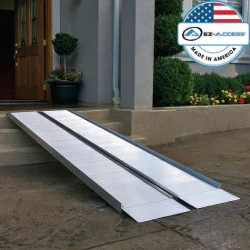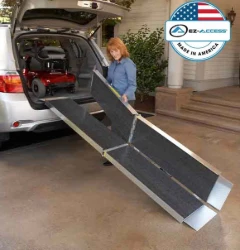
Quick answer: Choosing a portable wheelchair ramp starts with one measurement: the total rise, in inches, from the ground to the top of the step, curb or vehicle floor. Divide by your slope ratio for the minimum length, then confirm the weight rating covers user, device and any attendant, and that the ramp is wider than your wheels.
Portable ramps fold, carry and set up in minutes with no tools or permits, which makes them the go-to fix for a few steps at home, a curb, a doorway or a vehicle. The trade-off is that each ramp covers a limited rise. This guide walks through the six checks that decide which portable ramp will work for you, in the order to do them.
The 6-step portable ramp checklist
- Define where you'll use it: home entry, doorway, vehicle, or travel.
- Measure the rise: ground to the top of the landing, in inches.
- Pick a slope and length: rise divided by slope ratio = minimum length.
- Check weight capacity: user + mobility device + attendant + anything carried.
- Confirm width and device fit: usable width wider than your outside wheel track.
- Match the type and features: suitcase, trifold or threshold; non-slip surface, raised edges, secure top lip.
Step 1: Define where you'll use the ramp
Where the ramp goes shapes almost every other choice.
| Use | What matters most | Usually the best fit |
|---|---|---|
| Home entry | Enough length for a safe slope; stable top landing (1 to 3 steps, porch, stoop) | Singlefold or trifold suitcase ramp |
| Doorways and thresholds | Low profile, no tipping edge | Threshold ramp (rubber or aluminum) |
| Vehicle loading | Length for the floor height; locks or pins at the top | Trifold or longer singlefold ramp |
| Travel | Weight, folded size, carry handle | Short singlefold suitcase ramp |
| Public or business use | Temporary access only; codes apply to permanent access | Portable ramp as a stopgap. See ramp codes |
Step 2: Measure the rise
The rise is the vertical height the ramp must climb: from the surface where the ramp will rest to the top of the landing (top step, door sill or vehicle floor). Measure straight down with a tape measure, in inches. For vehicles, measure with the vehicle parked where you'll normally load, since a slope in the driveway changes the rise.
Measure the whole rise, not a single step. Three 7-inch steps is a 21-inch rise.
Step 3: Pick a slope, then the length
Slope is written as a ratio of rise to length. The lower the ratio, the gentler and safer the ramp.
- 1:12 - 1 inch of rise per 12 inches (1 foot) of ramp. The ADA standard and the safest choice for anyone propelling a manual wheelchair on their own.
- 2:12 - commonly used for power wheelchairs and scooters, or a manual chair pushed by an attendant.
- 3:12 - generally limited to loading an unoccupied device or a strong, experienced attendant. Not for anyone riding up on their own.
Always check your wheelchair or scooter manufacturer's maximum safe incline. It overrides these general guidelines.
| Rise | 1:12 (independent manual) | 2:12 (power chair / assisted) | 3:12 (unoccupied loading) |
|---|---|---|---|
| 3 in | 3 ft | 2 ft* | 2 ft* |
| 6 in | 6 ft | 3 ft | 2 ft |
| 9 in | 9 ft | 4.5 ft, round up to 5 ft | 3 ft |
| 12 in | 12 ft | 6 ft | 4 ft |
| 18 in | 18 ft | 9 ft | 6 ft |
| 24 in | 24 ft | 12 ft | 8 ft |
| 30 in | 30 ft | 15 ft | 10 ft |
*Shortest common portable ramp length. When a calculated length falls between sizes, round up.
Rule of thumb: at 1:12, the rise in inches equals the ramp length in feet. Portable ramps top out around 10 to 12 feet, so once an independent user needs more than roughly 10 to 12 inches of rise, a portable ramp can't hit 1:12 and a modular ramp system is the better fit. Use the ramp length guide to run your own numbers.
Step 4: Check the weight capacity
The weight rating has to cover everything on the ramp at once:
- the user
- the wheelchair, power chair or scooter (power chairs and scooters often weigh 150 to 350+ lb on their own)
- an attendant walking on the ramp while pushing
- bags, oxygen, or anything carried on the device
Typical ratings:
- About 600 lb - enough for most manual chairs and many standard scooters with their riders.
- 800 to 1,000+ lb - for power chairs, heavier users, bariatric equipment, or attendant-assisted use.
Choose a rating with headroom above your total. Loading a ramp near or past its limit shortens its life and risks failure.
Step 5: Confirm width and device fit
- Usable width: most portable ramps are about 30 inches wide. Measure your device's outside wheel-to-wheel width and choose a ramp with clearance on both sides, especially for power chairs and wide scooters.
- Full-width vs. track ramps: full-width (platform) ramps are the safer choice for most users. Two-piece track (channel) ramps are lighter but require lining up each set of wheels and do not work for three-wheel scooters.
- Ground clearance: long-wheelbase scooters and power chairs with low anti-tip wheels can bottom out where the ramp meets the landing. Check your device's clearance at the top transition.
Step 6: Match the ramp type and safety features
| Type | How it works | Best for | Watch for |
|---|---|---|---|
| Singlefold (suitcase) | Folds in half, carries like a suitcase | Short rises, travel, home steps | Gets heavy and bulky in longer lengths |
| Trifold / multifold | Folds into thirds or more | Longer rises, vehicles, frequent transport | More hinges to inspect |
| Threshold | Low wedge, rubber or aluminum | Door sills, sliding-door tracks, single small steps | Only covers a few inches of rise |
| Track / channel | Two separate narrow ramps | Lightweight loading of power chairs and scooters | Alignment risk; not for three-wheel scooters |
Safety features to require
- Non-slip traction surface that grips in rain and wet conditions.
- Raised side edges (curbs) that keep wheels from rolling off the side.
- A secure top lip or plate that sits flat on the landing with no gap or step.
- Stable, level footing at the bottom so the ramp can't rock or slide.
- Safety pins or locking hardware for vehicle and threshold connections.
Materials
- Aluminum - the most popular choice for portable ramps: strong, lightweight and rust-resistant.
- Rubber - used for threshold ramps; heavy enough to stay put and grips well.
- Steel and composite - less common in portable designs; check the weight before buying if you'll lift it often.
Portability and storage
If the ramp goes in and out of a vehicle often, weight and folded size matter as much as length. Look for a carry handle, a latch that holds it closed, and check the folded dimensions against your trunk or cargo area. Split the difference if needed: a shorter ramp for travel, a longer one kept at home.
When a portable ramp isn't the right choice
- The rise is more than about 10 to 12 inches for an independent manual user, or about 30 inches at any slope. You'll need a modular or permanent ramp. See choosing a ramp.
- The ramp will stay in place permanently, especially at a business. Permanent access has to meet local code and ADA requirements. See ramp codes.
- The route turns a corner or needs a landing partway up. Portable ramps are single straight runs.
- You need handrails. Most portable ramps don't include them.
Keep it in good condition
- Inspect before use for cracks, bent sections, loose hinges or missing pins.
- Clear dirt, leaves, ice and standing water from the surface.
- Store folded, in a dry place, out of extreme weather.
- Tighten screws and bolts on a regular schedule.
Full care guide: ramp care and maintenance. Measure the total rise in inches and divide by your slope ratio. At the ADA 1:12 slope, the length in feet equals the rise in inches, so a 6-inch rise needs a 6-foot ramp. Power chairs and scooters can often use 2:12, which halves the length. Most portable ramps are rated around 600 lb, and heavier-duty models reach 800 to 1,000 lb or more. Add the user, the device, any attendant and anything carried, then choose a rating above that total. A singlefold (suitcase) ramp folds in half and suits shorter rises and travel. A trifold ramp folds into thirds, so longer lengths stay compact enough for vehicles and frequent transport. Most are about 30 inches wide. Measure your device's outside wheel-to-wheel width and choose a ramp with clearance on both sides. Often, yes. A 2:12 slope is commonly used for power chairs and scooters, but never exceed the maximum incline in your device manufacturer's manual. The ADA sets requirements for permanent access at public places and businesses, including a 1:12 maximum slope, landings and handrails on longer runs. Portable ramps are designed for personal and temporary use and are not a substitute for a code-compliant permanent ramp. Tell us your rise, your mobility device and where you'll use the ramp, and we'll recommend the right length and model.Frequently asked questions
What length portable wheelchair ramp do I need?
How much weight can a portable wheelchair ramp hold?
What is the difference between a singlefold and a trifold ramp?
How wide should a portable wheelchair ramp be?
Can I use a steeper ramp for a power wheelchair?
Are portable ramps ADA compliant?
Need help choosing?